


 Developed by Providers, for Providers.
YAP-P is here to support you with access to resources that aid in caring for your young patients. If you are interested in receiving printed resources, please reach out to us at yapp@omh.bhdd.sc.gov.
Clinical Pearls & Guidelines
Clinical Pearls and Guidelines support providers in managing mental and behavioral health disorders in youth. These resources include information on how to assess for conditions, common misdiagnoses, treatment recommendations, and monitoring of the condition. We would like to thank the Massachusetts Child Psychiatry Access Program for allowing us to adapt these resources for South Carolina.
ANXIETY
AUTISM
ADHD
DEPRESSION
Depression Clinical Guidelines
OCD
PTSD
Patient and Family Materials
Parent Medication Guides were developed by the American Academy of Child and Adolescent Psychiatry (AACAP) and the American Psychiatric Association (APA) to help a child and/or adolescents’ caregiver make informed decisions about treating mental disorders. We also offer NIMH brochures and fact sheets on mental disorders and related topics. Click the link to access electronic versions.
ADHD
AACAP ADHD Parent’s Medication Guide (English)
ADHD with ASD
AACAP ADHD with ASD Parent’s Medication Guide (English)
Anxiety
AACAP Anxiety Parent’s Medication Guide (English)
AACAP Anxiety Parent’s Medication Guide (Spanish)
Autism
AACAP Autism Parent’s Medication Guide (English)
NIMH Autism Brochure (Spanish)
Depression
AACAP Depression Parent’s Medication Guide (English)
Emotional Outbursts
AACAP Emotional Outbursts Parent’s Medication Guide (English)
PTSD
AACAP PTSD Parent’s Medication Guide (English)
NIMH Coping with Traumatic Events Fact Sheet (English)
NIMH Coping with Traumatic Events Fact Sheet (Spanish)
Sleep Disorders
AACAP Sleep Disorders Parent’s Medication Guide (English)
Medication Guides
|
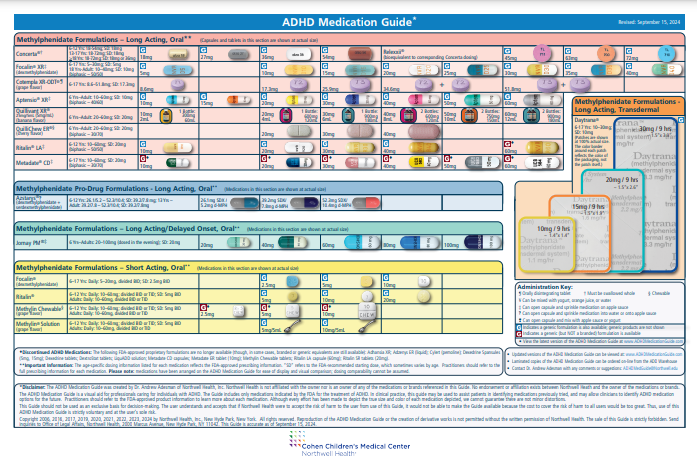 ADHD Guide
|
 Stimulant Guide
|
 Antidepressant Guide
Additional Resources
Trauma ScreenTIME Pediatric Primary Care Course
The ScreenTIME course equips professionals in child-serving systems with best practices for trauma screening. Designed to support early identification of traumatic stress in children, the course helps child-serving staff identify and support children suffering from traumatic stress as early as possible and connect those in need with effective services.
School Mental Health Quality Guide on Screening
Part of a collection of resources developed by the National Center for School Mental Health (NCSMH) at the University of Maryland School of Medicine, this guide contains background information on school mental health screening in addition to best practices, possible action steps, examples from the field, and supplemental resources.
American Academy of Pediatrics (AAP)’s Bright Futures Toolkit: Links to Commonly Used Screening Instruments and Tools includes tools for use during Bright Futures visits as well as screening and assessment tools for use at the discretion of the health care professional.
American Academy of Pediatrics (AAP)’s Screening Technical Assistance and Resource (STAR) Center focuses on early childhood screening and offers a Screening Tool Finder to help identify appropriate tools for assessing child development, perinatal depression and social drivers of health.
Massachusetts Child Psychiatry Access Program Primary Care Behavioral Health Screening Toolkit provides guidance on using standardized behavioral health screening tools in the primary care setting. It addresses clinical considerations, such as integrating screening into well-child visits and responding to elevated risk and includes several MassHealth-approved tools.